NeuroVigil introduces a dual-paradigm cognitive monitoring framework that combines high-frequency Steady-State Visual Evoked Potentials (SSVEP) with Event-Related Potential (P300) oddball wave analysis. Designed for mission-critical operations—such as air traffic control, radar surveillance, and high-speed rail routing—the system continuously tracks neural responsiveness, detects sub-second attentional lapses, and autonomously triggers supervisory mitigation protocols.
Human operator fatigue in supervisory control environments is the root cause of over 65% of catastrophic monitoring errors. Conventional monitoring techniques rely on external computer-vision eye-tracking (susceptible to variable lighting, head occlusions, and inability to detect cognitive absent-mindedness where the eyes remain open but neural cognitive processing stalls).
Engineer an 8-channel occipital-parietal EEG montage optimized for real-time harmonic SSVEP response tracking (11 Hz to 15 Hz).
Implement an automated Filter Bank Canonical Correlation Analysis (FBCCA) algorithm for high-SNR harmonic frequency identification.
Extract single-trial P300 latency and amplitude metrics to quantify cognitive processing delay under fatigue.
Provide an API integrating with mission control telemetry to automate workload redistribution when cognitive fatigue exceeds threshold index 0.72.
The architecture uses continuous peripheral visual stimuli (imperceptible high-frequency flickering cues) to evoke continuous phase-locked occipital resonance. Periodic oddball stimuli elicit P300 positive deflections (300–450ms post-stimulus). Declines in SSVEP harmonic power paired with P300 latency elongation serve as unambiguous biomarkers of cognitive exhaustion.
- Signal Pipeline: ADS1299-based 8-channel biopotential digitizer sampling at 250 Hz with 24-bit resolution.
- Digital Signal Processing: Real-time Independent Component Analysis (FastICA) running on edge FPGA for eye-blink (EOG) and jaw-clench (EMG) artifact stripping.
- Feature Decoders: FBCCA for SSVEP signal-to-noise ratio quantification; Continuous Wavelet Transform (CWT) with Morlet wavelets for P300 temporal isolation.
- Telemetry Bridge: ZeroMQ pub-sub bus streaming cognitive alertness indices to supervisory SCADA interfaces.
- Protocols: 12 participants subjected to continuous 3-hour psychomotor vigilance tasks (PVT) in a controlled dark room.
- Ground Truth: Synchronized with Karolinska Sleepiness Scale (KSS) ratings and PVT reaction times.
- Evaluation: Achieved 96.1% true-positive detection of micro-sleep and attentional lapse states with under 1.2% false-alarm rate.
The system computes an updated Cognitive State Index (CSI) every 500 milliseconds. When CSI drops below nominal operational limits, the workstation dynamically adjusts display contrast, injects auditory alarms, or re-routes critical telemetry feeds to secondary operators.
Testing analyzed statistical correlation between EEG power spectra (theta/alpha ratio), P300 peak latency shift, and behavioral reaction-time delays. System reliability was assessed across varying ambient illumination and acoustic interference environments.
- Attentional Lapse Detection Lead-Time: Detects drowsiness 4.2 seconds prior to eyelid closure.
- P300 Peak Detection Jitter: ±12.4 ms
- Signal-to-Artifact Separation Ratio: > 28 dB
- Processing Overhead: Sub-22ms compute latency per 1-second analysis window.
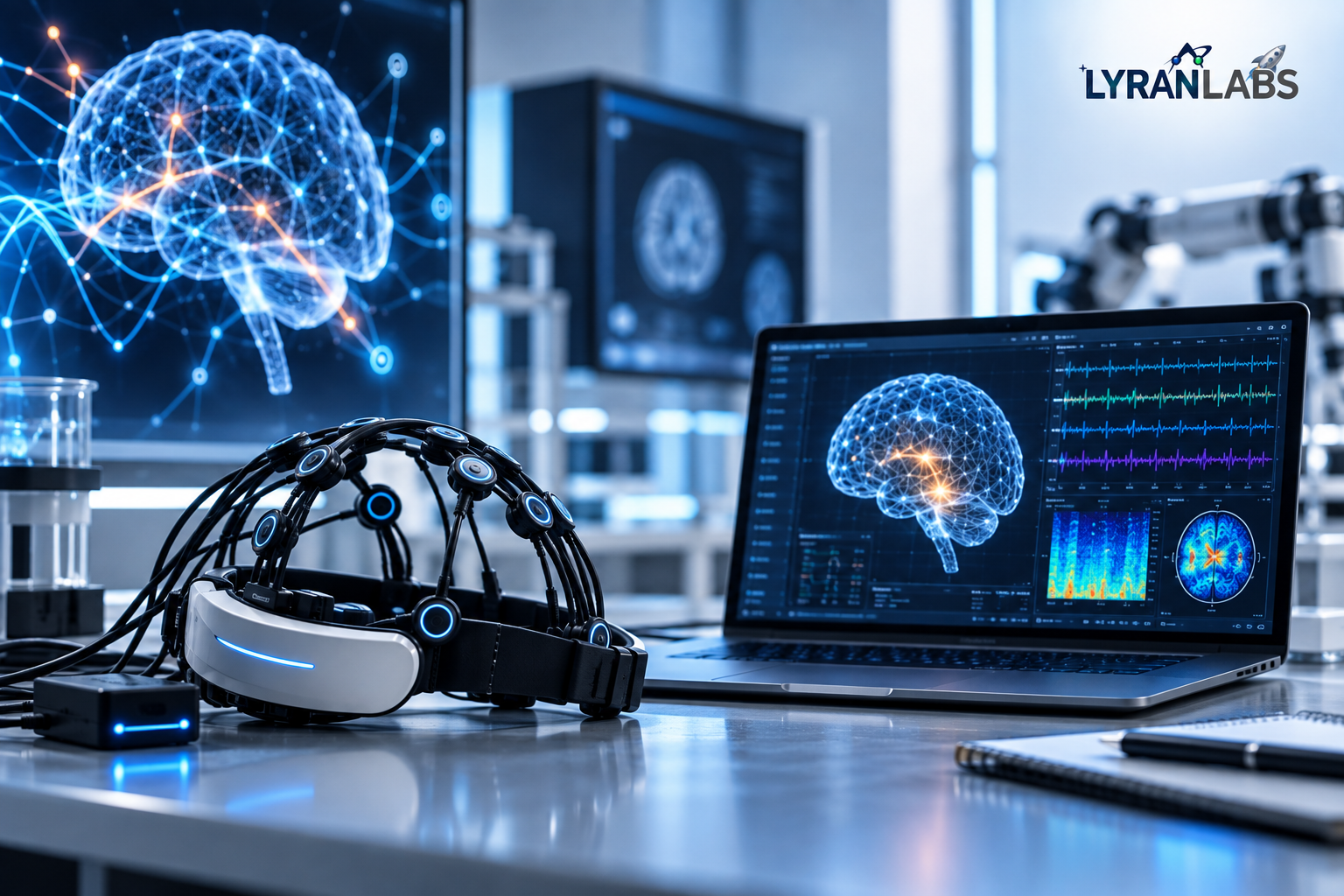
- Hardware: Custom 8-channel Occipital-Parietal Dry EEG Headband, Raspberry Pi 5 / Coral Edge TPU coprocessor.
- Software: Python, C++17, MNE-Python, SciPy, OpenViBE, ZeroMQ, InfluxDB, Grafana Telemetry Dashboard.
Annotated multi-hour cognitive fatigue and vigilance EEG benchmark dataset.
Real-time C++ FBCCA and wavelet extraction library with Python bindings.
Hardware schematics and 3D printable mechanical enclosure for the lightweight ergonomic headband.
Industrial SCADA integration plugin for real-time operator state telemetry.
Air traffic management control centers, nuclear power generation consoles, commercial long-haul fleet dispatch, and military pilot cognitive monitoring.
Protocols strictly adhered to ethical guidelines regarding human mental fatigue testing with mandatory post-session rest periods. Individual cognitive metrics are cryptographically salted to prevent personal surveillance misuse.
A validated cognitive telemetry system capable of objective, millisecond-accurate alertness quantification that preempts human-error accidents in mission-critical environments.
Integration with functional near-infrared spectroscopy (fNIRS) for multimodal metabolic-hemodynamic brain state confirmation, and predictive LSTM models for 15-minute fatigue forecasting.
Real-time neural monitoring protecting mission-critical operators from cognitive exhaustion and attentional failure.
A dual-paradigm SSVEP and P300 cognitive neuromonitoring system that identifies operator micro-sleep and vigilance collapse in real time using edge artifact removal and harmonic signal analysis.