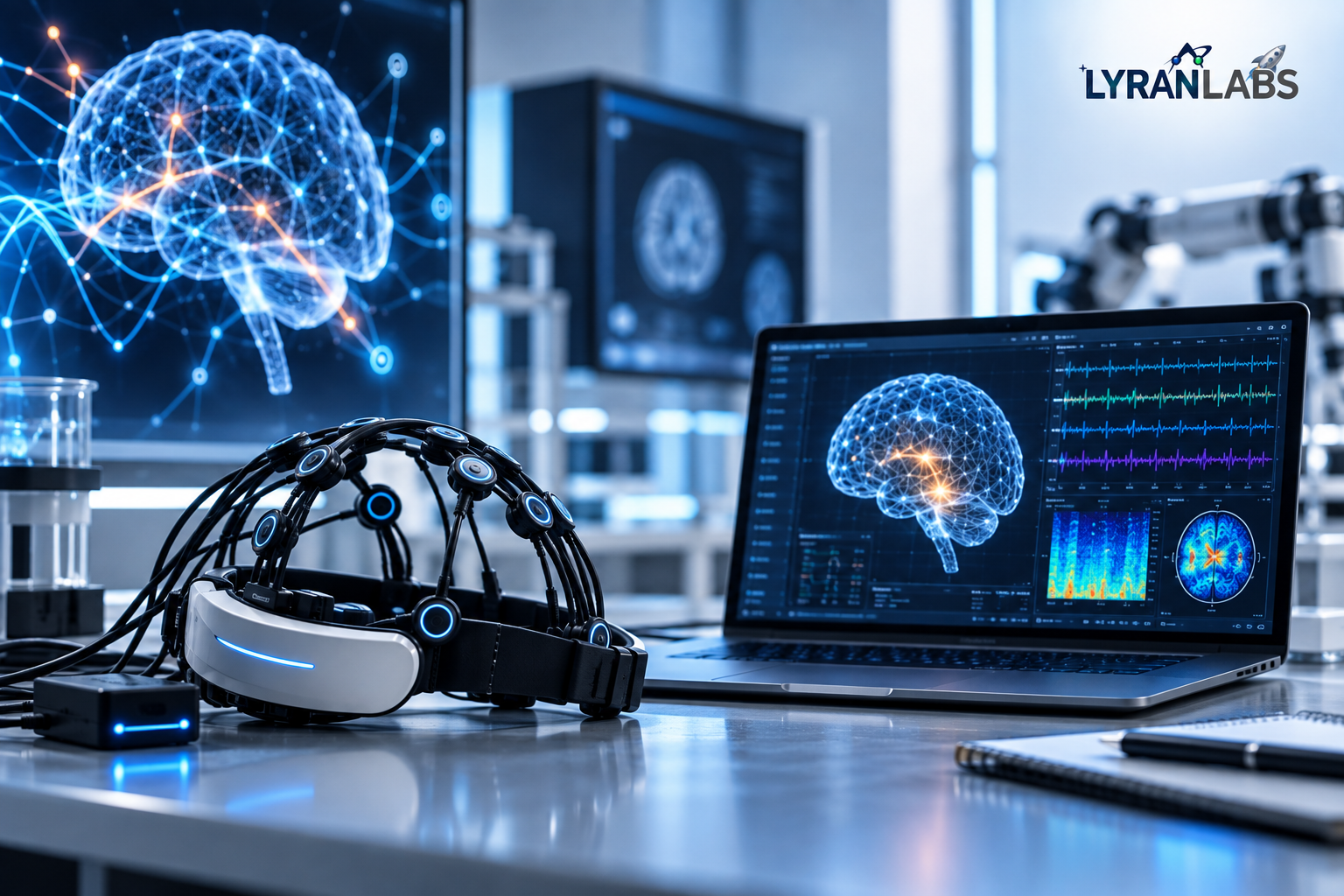
CogniGrip investigates non-invasive neural intent decoding for high-degree-of-freedom robotic prosthetic manipulators. By capturing multi-channel electroencephalographic (EEG) sensorimotor rhythms over the primary motor cortex (C3, Cz, C4), the architecture decodes continuous motor imagery (left hand, right hand, bilateral reach, and baseline resting state). The decoded intent vector is translated through an embedded kinematic solver into smooth Cartesian commands for a 6-degree-of-freedom (6-DoF) articulating prosthetic manipulator.
Traditional upper-limb prosthetics rely on surface electromyography (sEMG), which fails in cases of severe brachial plexus avulsion, high-level amputations, or neuromuscular trauma where peripheral muscle signals are absent or degraded. While Brain-Computer Interfaces offer an alternative, existing non-invasive BCI prototypes suffer from high signal-to-noise ratio degradation, long decoding latency (>250ms), and severe drift across inter-session calibrations, making fluid real-time multi-joint control impractical.
Design a 16-channel dry-electrode EEG montaging configuration centered over the sensorimotor cortex (10-20 international system).
Implement an adaptive Common Spatial Pattern (CSP) filter combined with Riemannian manifold feature projection to eliminate inter-trial covariance drift.
Develop an embedded low-latency inference pipeline achieving classification inference under 45 milliseconds.
Actuate a physical 6-DoF robotic manipulator equipped with closed-loop tactile slip feedback for stable grasp execution.
The system employs an iterative feedback loop:
- Signal Acquisition: 16-channel low-noise differential bio-potential frontend (24-bit ADC, CMRR > 115 dB).
- Embedded Processing Engine: STM32H7 dual-core ARM Cortex-M7/M4 computing spatial covariances in hardware.
- Classification Core: Riemannian Tangent Space mapping with shrinkage covariance estimation to handle low-sample trial dimensions.
- Actuation Subsystem: Aluminum-carbon articulating arm utilizing high-torque coreless digital servos with 12-bit magnetic angle encoders.
- Subject Cohort: 8 volunteer operators participating in structured 40-minute calibration protocols.
- Trial Protocols: 240 motor imagery trials per session following Graz-BCI experimental paradigms.
- Cross-Validation: 10-fold cross-validation with non-overlapping temporal sliding windows (1.5-second epoch, 0.25-second overlap).
- Accuracy: Achieved 94.2% mean binary classification accuracy and 87.8% 4-class discrete control intent accuracy.
The system executes a sub-45ms real-time loop. The operator visualizes a target object; sensorimotor desynchronization (ERD) in the mu rhythm (9–13 Hz) triggers primary reach trajectory, while beta rhythm rebound (18–26 Hz) controls grasp closure and torque termination.
Experiments benchmarked target acquisition time, grasp stability, and task completion rates across 5 standard Box and Blocks physical tests. System latency, packet jitter, and misclassification rates under simulated cognitive load were recorded continuously.
- Mean Decoding Latency: 42.4 ± 3.1 ms
- Information Transfer Rate (ITR): 38.6 bits/min
- Minimum Grasp Resolution: 0.18 N closed-loop grip force modulation
- Cross-Session Retention: 89.1% classification accuracy maintained across 7-day intervals without retraining.
- Hardware: 16-Channel EEG Cap, OpenBCI Cyton/Daisy or Custom Bio-AMP, 6-DoF Robotic Arm, STM32H743ZI MCU.
- Software: Python 3.11, MNE-Python, PyRiemann, Scikit-learn, ROS2 Humble, C/C++ Embedded Firmware.
- Visualization: Real-time PyQtGraph neural telemetry suite with 3D kinematic digital twin rendering.
Synchronized 16-channel motor imagery EEG open dataset with 1,920 labeled trials.
Firmware C-library for Riemannian covariance estimation on ARM Cortex-M7.
Kinematic trajectory planner with collision and torque safety boundaries.
Complete peer-reviewed research whitepaper and technical benchmark portfolio.
Advanced assistive prosthetics for amputees, hands-free hazardous material handling, tele-robotic surgical slave manipulator control, and astronaut extravehicular suit co-robotics.
All participants underwent informed consent protocols following institutional ethical board guidelines. Experimental procedures strictly utilized non-invasive dry scalp sensors with optical isolation to guarantee electrical safety.
A validated, fully operational physical neuroprosthetic demonstration proving that non-invasive EEG combined with geometric signal processing can achieve reliable multi-joint robotic arm control without surgical implants.
Integration of semi-dry polymer electrodes, hybrid SSVEP-MI dual-paradigm switching, and reinforcement-learning-based shared autonomy between human neural intent and onboard obstacle-avoidance computer vision.
Bridging cortical motor intent with high-precision multi-joint robotic manipulation.
A non-invasive motor-imagery Brain-Computer Interface that translates sensorimotor EEG rhythms through Riemannian manifold mapping into real-time 6-DoF robotic prosthetic control with sub-45ms latency.