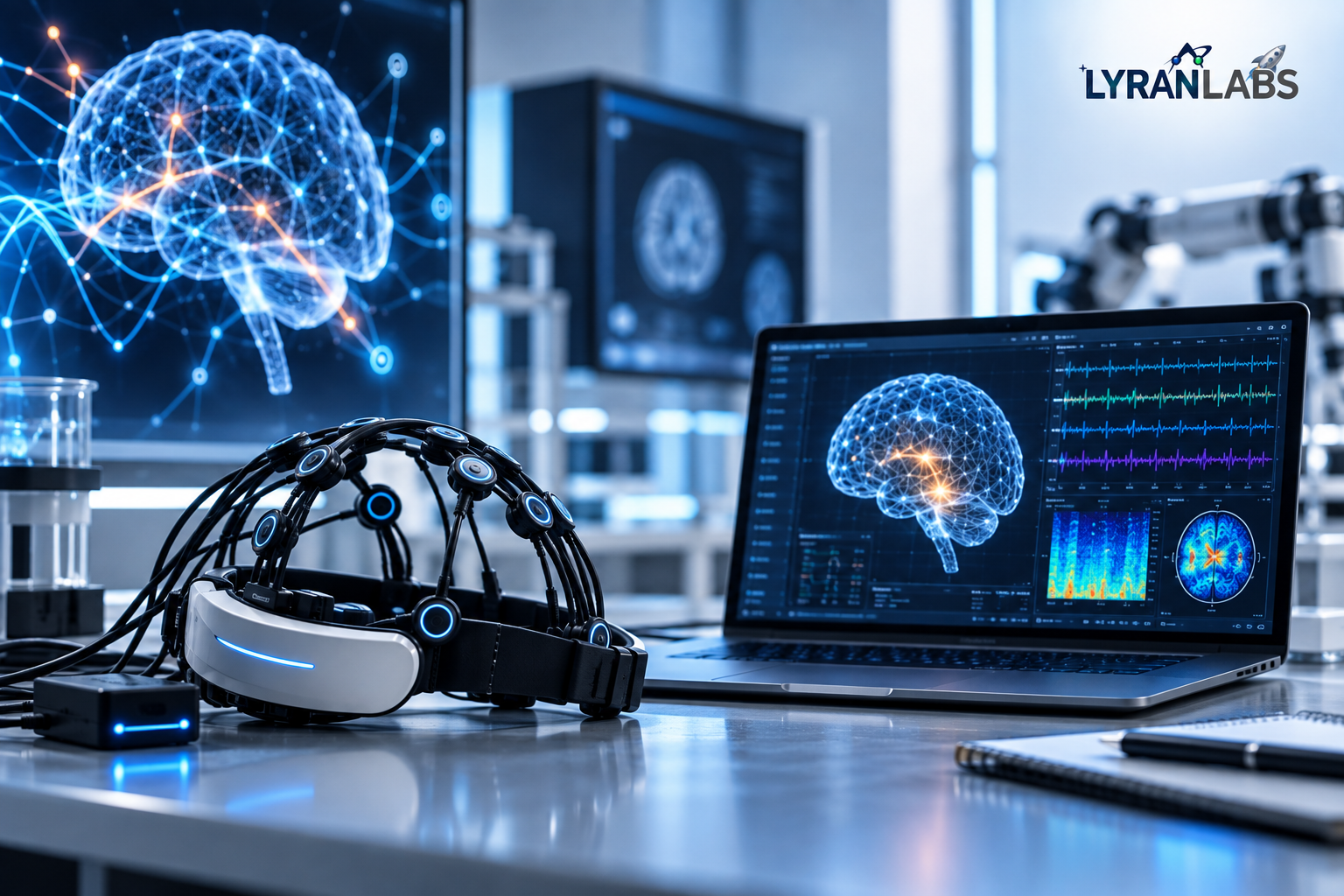
A Brain-Computer Interface is a computing system that translates information derived from brain activity into commands that can control an external application, device, or digital environment. EEG-based BCI systems use sensors placed on the scalp to capture electrical activity generated by the brain and then apply signal-processing and machine-learning techniques to identify patterns associated with a user's intended action.
This project investigates the development of a non-invasive EEG-based BCI platform capable of recognizing predefined patterns of user intent and converting those patterns into digital commands.
The research is organized around a complete engineering pipeline:
The objective is not simply to display brainwave activity, but to develop and evaluate a measurable end-to-end system in which neural signals are transformed into actionable commands.
Conventional human–computer interfaces depend primarily on physical movement, speech, touch, or conventional input devices. These interaction methods can become restrictive in situations where physical movement or traditional input is limited.
BCI research investigates an additional communication channel by extracting information from neural activity and translating it into meaningful commands. However, EEG signals are relatively low-amplitude and susceptible to artifacts, noise, electrode movement, environmental interference, and variations between users and sessions. Reliable BCI development therefore requires careful signal acquisition, preprocessing, feature engineering, model validation, and real-time adaptation.
This project addresses these engineering challenges by developing a structured experimental BCI pipeline and evaluating its ability to distinguish predefined neural activity patterns.
The primary objective of the project is to design and experimentally evaluate a non-invasive EEG-based Brain-Computer Interface capable of detecting predefined patterns of brain activity and converting them into real-time computer commands.
The research objectives include:
- Developing a reliable EEG data-acquisition pipeline.
- Recording and organizing EEG datasets under controlled experimental conditions.
- Applying digital signal-processing techniques to improve signal quality.
- Detecting and reducing common physiological and environmental artifacts.
- Extracting meaningful temporal and frequency-domain features from EEG recordings.
- Designing machine-learning models for intent classification.
- Evaluating decoder performance using objective statistical metrics.
- Implementing a real-time BCI interface for command visualization.
- Studying variations in performance across sessions and users.
- Establishing a reproducible framework that can be extended for future BCI research.
The project can initially focus on a controlled set of commands such as:
Left Intent / Right Intent / Rest State
For a more advanced implementation, additional BCI paradigms can be investigated, including:
Motor Imagery, P300-based interaction, or SSVEP-based command selection.
These paradigms are established areas of EEG-based BCI research.
A practical student implementation should begin with a limited command set and progressively increase complexity after establishing a stable baseline.
A non-invasive EEG headset or compatible EEG acquisition device is used to record electrical activity from the scalp.
The acquisition layer should record:
- Multi-channel EEG data
- Sampling frequency
- Electrode/channel configuration
- Timestamp information
- Experimental labels
- Session information
- Event markers
The experimental setup should maintain consistent electrode placement, recording conditions, and participant instructions to improve reproducibility.
Raw EEG data contains neural information mixed with unwanted artifacts and noise.
The preprocessing pipeline may include:
- Band-pass filtering
- Notch filtering where required
- Re-referencing
- Baseline correction
- Epoch segmentation
- Artifact detection
- Bad-channel identification
- Signal normalization
Important sources of contamination may include eye movement, muscle activity, electrode movement, and environmental interference.
The purpose of preprocessing is to improve the signal-to-noise ratio while preserving information relevant to the decoding task.
Following preprocessing, the system extracts features that may provide useful information for classification.
Potential feature families include:
Time-Domain Features
- Mean amplitude
- Variance
- Signal energy
- Statistical descriptors
Frequency-Domain Features
- Delta-band activity
- Theta-band activity
- Alpha-band activity
- Mu rhythm
- Beta-band activity
Time-Frequency Features
- Spectral power
- Power spectral density
- Wavelet-based representations
The exact feature set should be selected experimentally rather than assuming that one feature family will work equally well for every participant.
The extracted EEG features are provided to a machine-learning model that attempts to classify the user's intended state.
Possible baseline algorithms include:
- Linear Discriminant Analysis
- Support Vector Machine
- Logistic Regression
- Random Forest
More advanced research may investigate:
- Convolutional Neural Networks
- EEG-specific deep-learning architectures
- Temporal neural networks
- Adaptive decoding techniques
Classical machine-learning methods should be established as a baseline before introducing deep-learning architectures. EEG-BCI research commonly evaluates classifiers such as LDA, SVM and neural-network approaches for decoding.
The project should use a formal experimental methodology rather than evaluating the model only on the same recordings used for training.
The dataset should be divided into:
Where practical, the research should also investigate:
- Within-session performance
- and
- Cross-session performance
A stronger research study can additionally investigate whether a model trained on one participant can generalize to another participant, although subject-to-subject EEG variability makes this a challenging research problem.
After offline model validation, the trained decoder can be integrated into a real-time application.
Example interaction:
The command output could control:
- A computer interface
- Cursor movement
- A digital dashboard
- A virtual robot
- A simulated robotic arm
- Smart-home functions
- A game environment
- A visualization platform
The project should initially control a simulated or non-critical system, allowing the research team to evaluate the BCI safely without presenting the prototype as a medical device.
A controlled experimental protocol should be established before data collection.
For example, a participant may be instructed to perform predefined mental tasks while EEG data is recorded.
Each trial can contain:
Multiple trials should be recorded for each class.
The experiment should maintain:
- Consistent task duration
- Consistent instructions
- Controlled recording environment
- Proper electrode preparation
- Participant/session metadata
- Event markers
- Repeatable trial structure
The complete experiment should be documented so that another researcher can reproduce the study.
The system should be evaluated using quantitative performance metrics rather than relying only on visual demonstrations.
Recommended metrics include:
Classification Accuracy Percentage of correctly classified EEG trials.
Precision How reliably the system identifies a particular command.
Recall How consistently the system detects the intended class.
F1 Score Balance between precision and recall.
Confusion Matrix Detailed analysis of classification errors between command classes.
Latency Time required to convert incoming EEG data into a system command.
False Activation Rate Frequency of unintended command generation.
Information Transfer Rate A commonly used BCI performance measure for evaluating communication efficiency.
Session Stability Change in performance across repeated recording sessions.
A professional BCI study should evaluate both decoder performance and real-time usability, because a model with high offline accuracy may still face practical challenges during live operation. Research literature emphasizes real-time signal-processing and user-system adaptation as important considerations in practical EEG-based BCIs.
The project can be developed around the following research questions:
- Hardware
- Non-invasive EEG headset
- EEG electrodes/sensors
- Computer for signal acquisition
- Optional microcontroller
- Optional robotic or IoT prototype for demonstration
- Software
- Python
- NumPy
- SciPy
- Pandas
- MNE-Python
- Scikit-learn
- PyTorch or TensorFlow for advanced deep learning
- Matplotlib / Plotly
- Jupyter Notebook
- Git/GitHub
- Application Layer
A real-time dashboard can be developed to display:
- EEG channels
- Signal quality
- Frequency spectrum
- Detected features
- Model prediction
- Confidence/probability
- Command history
- System latency
- Session statistics
The completed project should produce the following outputs:
EEG Dataset
A structured dataset containing recorded EEG signals, timestamps, trial labels, and experimental metadata.
Signal-Processing Pipeline
A documented preprocessing pipeline for filtering, artifact handling, segmentation, and feature extraction.
Machine-Learning Model
A trained and validated EEG classification model.
Real-Time Decoder
A software module capable of processing live EEG signals and generating predicted commands.
Visualization Dashboard
A research dashboard displaying neural signals, decoded intent, system status, and performance metrics.
Experimental Report
A formal research report documenting methodology, experiments, results, limitations, and conclusions.
Reproducible Codebase
Version-controlled source code with documented dependencies, configuration, dataset structure, and experiment procedures.
Demonstration Prototype
A controlled human–machine interaction demonstration showing how decoded commands can operate a digital or robotic system.
The technology investigated in this project has potential relevance to several areas of human–machine interaction and neurotechnology research.
Assistive Interfaces
Development of alternative computer-control mechanisms for users who may have limited conventional input options.
Robotics
Investigation of neural intent as an additional control signal for robotic systems.
Smart Environments
Research into hands-free interaction with connected devices.
Human–Computer Interaction
Development of alternative interaction mechanisms beyond keyboard, mouse, touch, and voice.
Rehabilitation Research
Investigation of BCI-based feedback and motor-intent interfaces in controlled research settings.
Extended Reality
Potential integration of neural-state information with virtual and augmented environments.
Neurotechnology R&D
Research into signal decoding, adaptive algorithms, real-time inference, and neural data visualization.
BCI development is increasingly treated as a multidisciplinary field spanning neuroscience, signal processing, machine learning, engineering, software, human factors, and regulatory considerations. IEEE also identifies standardization, terminology, reporting, and responsible neurotechnology development as important areas for the broader BCI ecosystem.
Because the project involves human neural data, the research process should include appropriate participant information, consent procedures, privacy protections, secure data handling, and clearly defined experimental protocols.
The project should avoid presenting the prototype as a medical diagnostic, therapeutic, or clinical device unless it has undergone the appropriate scientific, ethical, and regulatory processes.
For example, the U.S. FDA has specific guidance concerning implanted BCI devices and emphasizes considerations related to nonclinical testing, clinical study design, safety, and effectiveness.
For a student research project, a non-invasive EEG prototype for controlled research and demonstration is therefore an appropriate scope.
The expected outcome of the project is a functional experimental BCI pipeline capable of acquiring EEG data, processing neural signals, identifying predefined patterns of brain activity, and converting those patterns into real-time digital commands.
More importantly, the project is intended to establish a repeatable research framework rather than a one-time demonstration.
The final system should allow researchers to compare:
This creates a foundation for subsequent research involving larger datasets, additional BCI paradigms, improved decoding models, adaptive algorithms, multimodal sensing, and more complex human–machine interfaces.
Future versions of the project may investigate:
Adaptive BCI Models Algorithms that continuously adapt to changes in an individual's neural patterns.
Deep Learning for EEG Investigation of CNN, recurrent, transformer-based, or other neural architectures for EEG decoding.
Multimodal Neurotechnology Combining EEG with eye tracking, electromyography, motion sensing, or other physiological signals.
Brain-Controlled Robotics Using decoded intent to control simulated or physical robotic systems.
BCI + Computer Vision Combining neural intent with visual context to improve machine decision-making.
Edge AI BCI Exploring low-latency neural decoding on local/edge hardware.
Cross-Session Generalization Investigating methods for reducing the need for repeated calibration.
Human–Machine Co-Adaptation Studying how both the user and decoder can adapt during prolonged interaction.
Recent NIH-supported research illustrates the broader direction of the field, including work on wearable/non-invasive EEG systems and advanced BCI approaches for communication and control.
Decoding neural signals to explore the next generation of human–machine interaction.
An experimental EEG-based Brain-Computer Interface that combines neural signal processing and machine learning to decode user intent and translate brain activity into real-time digital commands.
NeuroCommand explores the development of a non-invasive EEG-based Brain-Computer Interface capable of decoding predefined patterns of neural activity using digital signal processing and machine learning. The project integrates EEG acquisition, preprocessing, feature extraction, classification, and real-time command generation to investigate a new paradigm for human–machine interaction.